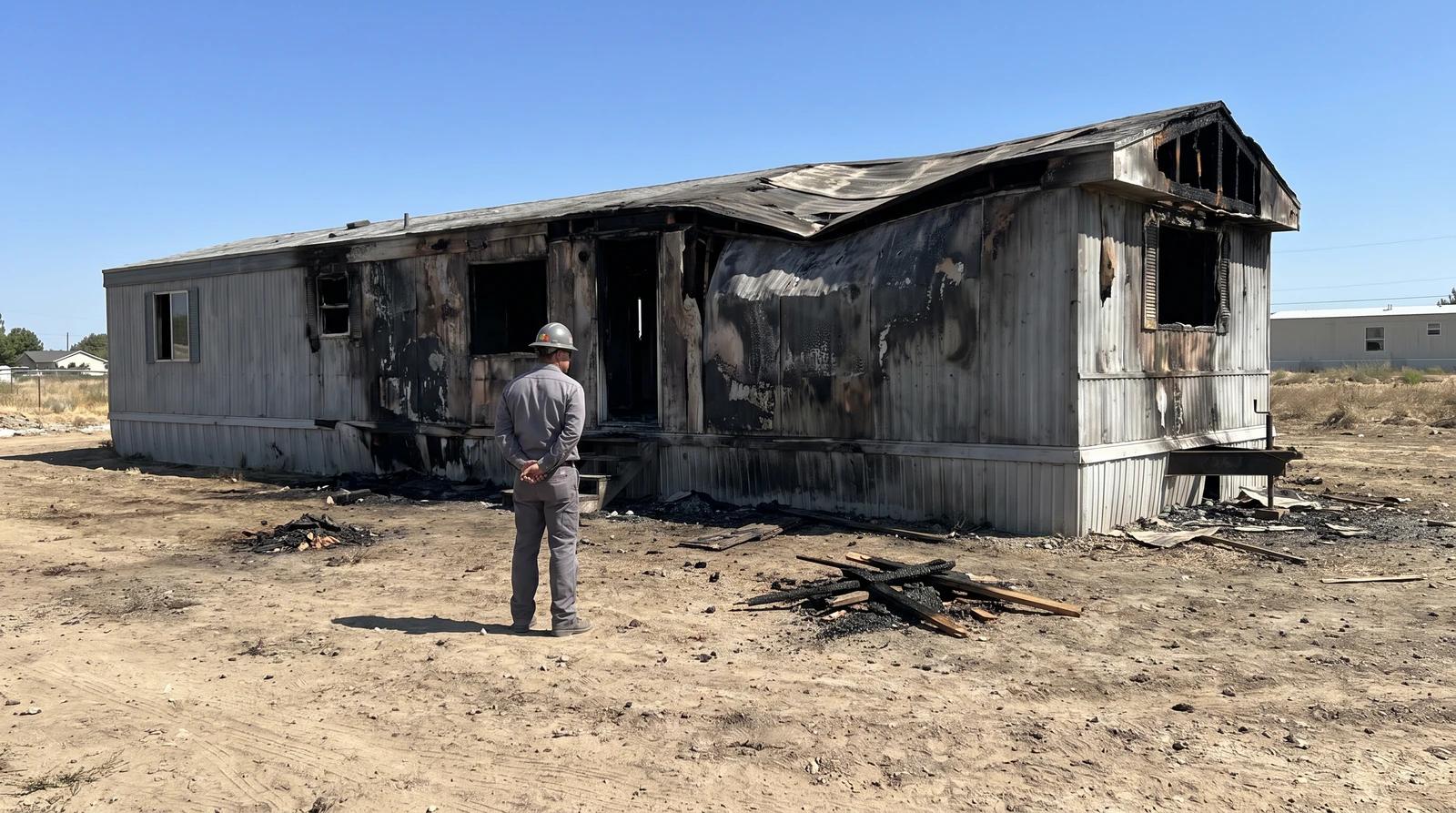
Manufactured Home Demolition Boise: After a Mobile Home Fire
Most calls we get for mobile home demolition in Boise are pretty routine. The fire calls aren't. Weeks after the fire, you walk up to what's left of the trailer and it still smells like wet ash and melted plastic.
The fire department has come and gone, and now you're standing in the yard wondering what happens next. This is the plain version, from the crew that does the teardown.
Call your insurance company before you call us
This is the part people get wrong, and it's easy to see why. You want the mess gone. The neighbors want it gone. Maybe the park manager is already asking.
But if you're insured, the adjuster needs to see the home as it is. Clearing it early can make your claim harder. That's a bad trade for a few more days of looking at a burned shell.
So get the adjuster out first. Let them take their photos and measurements, then ask them straight out whether demolition and debris removal are covered. Plenty of policies cover some of it, but you want that in writing before anybody swings a hammer.
Yes, we'd love the job. Honestly, though, waiting a week for the adjuster beats rushing and leaving money on the table.
What a fire changes about mobile home demolition in Boise
A regular single wide comes apart in a fairly predictable way. A burned one doesn't.
The floor may be soft or half gone, so nobody walks across it without checking first. The roof can sag or drop with little warning. Walls that look fine from the street are sometimes just paneling hanging onto a charred frame.
Then there's everything inside. Furniture, mattresses and carpet soaked by fire hoses get heavy and nasty. Appliances, propane bottles and whatever's in the shed or under the skirting all get checked before anyone moves them.
Age matters too. A lot of the trailers we take down around Garden City and Caldwell were built decades ago, and some older materials need an asbestos check before demolition. A fire doesn't make that go away. If anything, testing matters more, because damaged material breaks apart more easily.
Heads up: Before the estimate, have the power and gas companies shut off service at the meter, not just at the breaker. We won't start on a fire-damaged home until both are confirmed off, and making that call early keeps the job from stalling while you wait on it.
How manufactured home demolition in Boise actually goes
Once the adjuster's done and the utilities are off, the rest is simple enough.
We come out for a free on-site estimate. We walk the lot, look at how bad the damage is, check what's under the home and around it, and give you a firm price before anything gets touched. That price is based on the space and the work involved, and no surprise fees show up later.
Next comes the permit. Demolition in Idaho generally needs one from whichever city or county the home sits in, and Boise, Meridian, Nampa and Ada County each run their own process. What's required out in Kuna isn't always what's required on the Bench, so we'll tell you what we know and the local building department has the final word.
After that, the teardown goes on the calendar. On a burned home we go slower than we would on a clean one. The roof comes down in a controlled way, the walls follow, and we sort material as we go.
What can be recycled gets recycled, mostly the steel frame and any metal that made it through. Fire-damaged stuff usually can't be donated, which is a shame, though things from an untouched shed sometimes can. The rest goes to the Ada County landfill, or the Canyon County one if you're out by Nampa or Caldwell.
How long does it take?
Fair question. The teardown itself on a single wide is the quicker job. A double wide, or a home with extra damage, takes longer, and so does a lot that's hard to get equipment onto or a home with a lot of material to sort.
The waiting is the slow part: the adjuster, the shutoffs and the permit. Get those three moving right away and the whole thing goes a lot faster.
What happens to the lot afterward?
That depends on whether you're in a park or on your own land.
In a park, the manager usually wants the space cleared down to the pad so the next home can come in. On your own property, you get more say. Some people want every pier block and tie-down pulled, while others are setting a new home in the same spot and want the anchors left alone.
Tell us your plan. It changes what we take out and what stays.
One more thing. Burned homes leave more small debris behind than you'd expect, like glass, nails and bits of melted siding. We rake and pick up everything we can see, but if kids or dogs will be on that ground, take one more walk around after we're gone.
The bottom line
A fire is rough enough without the cleanup piling on. Call your insurance company first, get the utilities shut off, then get a firm price from someone who's actually taken down burned trailers before.
If you're anywhere in the Treasure Valley and want us to take a look, give us a call at (208) 247-3193. The estimate's free, we take cash, card or Venmo, and there's no pressure either way.
Get a Free Estimate
We'll come look at your mobile home and give you a complete price—no surprises, no hidden fees.
Call (208) 247-3193More From Our Blog
Mobile Home Demolition Boise: Asbestos in Older Trailers
Older trailers can hide asbestos in floors, ceilings and roof coatings. Here's what to check before mobile home demolition in Boise and the Treasure Valley.
Mobile Home Removal Boise: Utilities to Shut Off Before Demo
Before a mobile home comes down in Boise, the power, gas, water and sewer have to be handled. Here's who to call, what to cap, and what slows it down.
Mobile Home Removal in Boise When You Inherit an Old Trailer
Inherited a lot with an old trailer on it? What to sort out before mobile home removal in Boise: ownership, probate, the cleanout, utilities and permits.
